Blog Feed

Figuring out the right relational approach

Perhaps I am approaching this prompt a bit differently than most of the group because I have spent the last five and a half years building the relationships necessary for determining two of the three key questions Felipe outlines in his prompt. Are they a leader? What decision making power do they have? I have a pretty clear sense of this for most of the organizations we hope to work with in this co-op model.

The middle question–What institutional needs do they have?–is not always as easy to answer, even for the people I’m meeting with regularly. I find churches and nonprofits are often trying to solve a short term problem when a longer-term, or maybe bigger fix is a bigger/better solution. It can be hardest to convince a volunteer, because that’s the role of most of the folks we relate to around these questions, that a more involved solution is going to be less of a hassle in the long run for them. So building a relationship and trust and having a lot of patience has been key for us as we work at bookkeeping and will be key to having success with expanding into the co-op.

Reading through the questions provided for the prompt, I find I really struggle to respond positively to the questions posed. I worked in sales for 10 years so I certainly understand the potential value of showing vulnerability and interest in the other person as a way of building a relationship. In peer-to-peer relationships, the idea of vulnerability feels more comfortable. But I realize that as a youngish woman who is generally relating to old, white men on finance committees or property committees, vulnerability often means something different to me. It can often set up a dynamic where my authority, already in question because I’m a woman, is further diminished.

What does vulnerability mean to PRC’s CPA who has more than 25 years of experience when she is being lectured by a 80 year-old man, who only doubts her ability ultimately because she is a woman. What does it mean for our accountant who has to exert her authority with a man who questions her decisions without reason other than she’s young?

Vulnerability can mean many things, but for many of us, calibrating it so that it allows for relationship building without the diminishment of self or authority can be tricky. I felt like I needed to name the response I had when reading the prompt. None of this is to say that we shouldn’t be friendly or authentic or acknowledge what we don’t know, but there are challenges for many of us in knowing how to balance all of this, I think.

My general approach to building relationships is to ask genuine questions and listen as fully as I can to the other person’s response. Often I have an idea how I want to work at a problem, but many times talking with someone pushes me to reconfigure that solution into something new. And after listening to their thoughts, frustrations, and ideas, I’ll run my adapted idea by them for their thoughts and suggestions. I find that this approach often allows for by in from that person from the beginning and helps them feel like they’re part of the team.

I am being open and potentially vulnerable through this approach, but I’ve often found that it’s a better way for me to establish a peer-to-peer relationship that in the long run allows for more collaboration. If we can find a way to work together through offering ideas and solving problems together, we build a level of trust that creates good boundaries and respect. I don’t think I’m answering this question as you hoped, but I felt like I needed to be honest about what kept tripping me up as I worked at my response.

RS: First, thanks to everyone for your responses. I appreciate many of you sharing your own experiences with this. I learned a lot from your comments. Thank you.

I think it’s important to say that my vulnerability is often assumed. Older men often see me as a daughter or granddaughter first and a professional as a distant second. Perhaps this is an experience different that what other people know, but it’s my regular frame of reference.

Felipe, it would be helpful for me to know if many of the churches you’ve worked with through CPA are fairly large with a staff person dedicated to facilities or large capital expenses. If that’s the case, then it’s very different from many of the churches I work with here in Lancaster. Many are worshiping 20-50 people on a Sunday. They’re tending an enormous building and they’ve given much of their time and money to something that they believe is failing quickly.

I’m deeply empathetic to this and understand that a leadership role in a congregation was once a honor but now often feels like a burden. I understand that a lot of the emotional flailing that I encounter is the result of fear, embarrassment, and uncertainty. I know that standing still and letting the slow drip of failure happen can be less scary than taking a major step in a new direction, even if that step could save them a lot of psychic energy.

I’m OK with all of that–I have enormous amounts of patience. But I also need to draw lines in terms of my time and the level of service we provide. We can’t offer these services if we can’t make them somewhat efficient. It’s not a good idea for me to go many, many rounds with a volunteer who refuses to work within our system. I also need to protect my employees. It’s more often that I need to set boundaries and back them up when they insist on professionalism. I can’t lose an employee because a volunteer at a church is asking her, without realizing it, to violate professional standards or excellence.

It’s a balancing act. And I think it’s important for us to discuss that, too.

Stepping into unknown territory

Yessica, Paul and I spoke on the phone on yesterday to create a prioritized list for our initial relational meetings. I have not set up my meetings yet, but intend to send out emails for that purpose tomorrow. The three entities I hope to connect to: Denver Museum of Nature and Science, the Science and Cultural Facilities District, and Mile High Early Learning. A staff member at the Museum is already involved with the Denver Anchor Network and we have a good working relationship. Having a conversation with her about the CPA model will be fun and will hopefully open up avenues to connect with other leaders at the museum. I will be cold calling to SCFD and Mile High Early Learning. If that isn’t successful, Paul and Yessica have people they can contact to help me get the attention of those entities.

First some background on these entities:


Denver Museum of Nature and Science: one of Denver’s largest most successful museums in terms of resident and tourist visitation. I am starting to get to know them better. My contact is the Director of Early Education and Learning. She is keenly attuned to issues of racial equity and plays a leadership role in guiding the institution to change its ways and inch along towards dismantling the predominant white male perspective that pervades traditional museum culture. Anchor mission and community wealth building were new terms to her when we first met, but she quickly grasped the concepts and understood its relevance to the changes she wants to see at the museum, as well as more broadly in the community.

The Science and Cultural Facilities District (SCFD) is a tax, voted on by residents of the seven metro Denver counties, with the proceeds being distributed to arts and culture organizations in the seven counties. It was created in the late 1980s when the area’s arts organizations were struggling. It has led to very healthy balance sheets for our large arts institutions, who receive the majority of the funding. Medium and small arts organizations split a much smaller pool of funds. The tax is voted on every ten years, with the most recent re-authorization vote in 2018. It passed again, but there was considerable push back from smaller, more grassroots arts organizations, many of whom are led by and serve people of color. Consequently, the SCFD and the large institutions that receive the bulk of the tax proceeds are feeling the pressure of needing to become more relevant to communities of color, instead of primarily focusing their offerings to wealthier, white audiences. We want to explore the CPA concept with the SCFD thinking they could help us connect to the organizations that receive SCFD funds. We believe that CPA offers an avenue for them to demonstrate a greater commitment to creating a healthier community for all.

Mile High Early Learning (MHEL) is Denver’s oldest and largest provider of quality early childhood care and education. Their curriculum is based on the Montessori method. They operate seven early learning centers and two drop-in centers. Ninety-four percent of the families they serve live at or below the federal poverty level. They have an annual budget of $10 million. We know nothing about their procurement practices, but are excited to see if the CPA model will intrigue them.

What information or stories from your background do you plan to share with the person you’re meeting with so your meeting feels relational, rather than transactional?

With SCFD and MHEL I will share an explanation of the Center for Community Wealth Building and the Denver Anchor Network and our goals to change the current economic development paradigm in Denver, building an economy designed to serve people and strengthen local communities, with an emphasis on greater economic opportunity for people of color. The racial wealth gap is a reality that MHEL is very well aware of, so it will be interesting to see whether leveraging their purchasing to build community wealth is something that resonates with them.

I’m stumped right now to think of what information or stories from my background I will share. Most meetings I have feel more relational than transactional to me, yet I am learning through this CPA experience that I could bring more intentionality to my interactions. At the same time, I also feel my resistance to being more strategic about how I relate to people. It feels more natural for me to just be myself and speak from the heart about the work we are doing.

I genuinely care about people and am interested in people and it seems that is how most people experience me. It is also important to me that I have fun doing what I’m doing. I love to explore ideas with people and see how we can advance a common agenda — in this case it is about creating win-win situations for organizations and businesses, ultimately leading to a more just and healthy community. It’s fun to imagine the possibilities. Going to that happy place is what helps me have meetings that are relational.

Where will you take a risk? How you will you model vulnerability in a way that invites a deeper more meaningful sharing from the other person?

I think that going in without all the answers and without a solid case-making proposition is perhaps modeling vulnerability. I will let people know up front that we are exploring an idea and are looking for early adopters who are willing to create this with us. I don’t try to make things appear more sure or certain than they are. I don’t sugar coat. My favorite zone is trying to figure out how to get something done and I believe that the quickest way to do that is to be as forthcoming as possible with both the upsides and the downsides.
With SCFD and MHEL, I will let them know that they are my first “cold calls” for this project and that it’s exciting to share this idea with them and also scary.

People like to talk about themselves. What questions about their background do you plan to ask? What are you genuinely curious to know? How will you move on if they’re talking too long?

I am curious about their appetite for leveraging their institution’s purchasing power. I wonder about how they feel about the gentrification that’s going on in Denver? How it is affecting them personally and their organization? I’m wondering whether their organization has started having conversations or is taking any action related to the impacts of gentrification.

With SCFD, I would like to get a better feel for how committed the organization is to becoming more relevant to the entire community and how they are looking at the issue of equity. They are a tax-funded entity, with the bulk of the resources going to the largest cultural organizations (e.g. The Colorado Symphony, Denver Art Museum, Denver Museum of Nature and Science, Colorado Ballet) that have a predominantly affluent white audience. They are taking some actions, but it isn’t clear how deep a commitment they have to address the inequities of their system. I am curious how their relatively new E.D. feels about all of this. We aren’t interested in helping them put a good public face on the organization (something CPA involvement could provide) if it really doesn’t reflect a deep commitment. So, I’d like to learn where she is coming from with respect to the larger controversy they are wrestling with.

From MHEL’s annual report, it appears they have noticeably strong business and corporate relationships. MHEL is a beloved organization amongst a lot of local movers and shakers. The relationships have been built over time (the organization was founded in 1970 by an icon in the early learning field who retired several years ago) and I’m curious how they nurture those relationships. It’s pretty phenomenal, as the organization serves about 1,000 children from very low-income families each year. I’m curious whether the concentration of business leaders on her board impacts the business aspects of the organization.

I’m obviously more curious at the outset about the organizations, and less curious about the individual I will be meeting with. I need to work on that! Each individual that I meet with is passionate about their work and so talking about their organization is deeply personal to them and I think there will be opportunities to connect on a personal level.

If the person is talking too long, I might let it go on if it feels like it is leading us to fertile, but unexpected territory, but most likely I would probably interject with an apology that I took the conversation off-track and out of the desire to respect the time allotted for our meeting, I’d like to tell them a bit more about the CPA model so I can get their feedback on it.

How do you balance the relational versus transactional nature of your work today? When are you good at this? When do you struggle with it? What would you like to get better at?

Because my work is so mission oriented, the lines between relational and transactional are often very blurry. I try to be very respectful of people’s time and recognize that for the most part I am clueless about all the demands on their time. I like to be as generous as I can with timelines and expectations as I don’t want to add stress for people.
I definitely understand that relationships are key to the success of any venture. An important component of my work is connecting people in the community to institutions, helping bring them into relationship. I find it very satisfying to be able to help build bridges that connect people in the community to people in institutions — bringing together people whose paths don’t cross naturally. When this happens, people feel good. It’s wonderful to witness and it’s wonderful to play a role in helping that happen.
Feeling pressed for time is something that feels like an epidemic these days. My personal relationships suffer because I am so focused on my work. I would definitely like to get better at carving more time to nurture my personal relationships.
With rare exception, I feel very good about the many people that I get to work with and so even though most of our time together is focused on accomplishing the work at hand, I feel a connection that is personal. Perhaps this is my own delusion, but I am grateful that this is how it feels! As an introvert, I also relish my down time and spending time by myself and so while I know there is value in building and nurturing new relationships, I am in a period of my life where I indulge my enjoyment of time to myself.

SATURDAY’S REFLECTIONS:

Once again, thanks to all who commented on my post and asked such thoughtful questions to help me go deeper. It is a treat to experience such a wonderfully generous and supportive community. For my reflection, I’m going to spend some time noodling over the encouragement to be able to articulate the story of self, to get more in touch with why I show up for this work. It feels akin to if you asked me why I put sunscreen on when I go outside. My skin is fair and I burn easily and I need to protect it. The answer to why I do what I do feels similar to me — it is a condition of who I am on this planet. Honestly, I’m baffled that everyone isn’t called to address the inequities and atrocities that we all live and breathe. How our species is able to see suffering and injustices on a continual feed is the question that I have. I am baffled that the words of all the various religions that many people listen to on a weekly basis don’t sink in and translate to how we live our lives. I am inspired by the words and speeches that describe democracy and don’t understand why those words don’t reflect reality. I guess I have always taken things literally. I believe with all my heart that we all deserve to be free and that justice and opportunity are fundamental and there is no explanation for why it is only supposed to be applied to privileged white people. To see so many people and communities that can’t achieve their potential because of deliberate choices made by our economic and political systems is criminal in my view. I will keep digging and see if I can describe an ‘ah ha’ moment for myself when this became my worldview. I know that from a young age (5 or 6) I was disturbed by inequality. I noticed that garbage men were treated differently from other people. I didn’t understand why. My first job aspiration was to be a garbage man, because I thought if people who looked like me were garbage men, then people would start treating them differently. I wanted to live in a world where people were loved regardless of what they looked like or what work they did and instead were loved because of the quality of their character and that we didn’t judge a person’s character by what they were wearing or their skin color or what kind of house they lived in or what gender or religion they were.

I’m still just that little girl that wants so much for everyone to belong and for everyone to look out for each other and to practice the Golden Rule. Eleanor Roosevelt’s quote, something to the effect of, ‘we all do better when we all do better’ just seems so basic and obvious to me.

Another trait of mine is that once I know something, I think that everyone knows it too. Maybe that comes from being the youngest in my family and always being the last one to figure something out! By the time I knew something, I was just catching up to the rest of the household. I am slowly coming to realize that just because I know or understand something doesn’t mean that everyone else does, too. Yes … seems pretty basic, I realize. I’m just figuring that out!

It’s also true that I’m just not that interested in talking about myself. I already know how I see the world and I have heard myself plenty of times. I’d rather hear other people’s stories. I haven’t heard those. I had a boss once who was an eloquent speaker and when I went to work at this organization many people said, ‘oh you are so lucky to get to work with X.’ However, I soon learned that X’s oratory also translated to our regular check-ins. I heard those same speeches, those same ideas over and over. I was ready to move on … what’s next? My point here, i’m not interested in my story because I’m too familiar with it. And since many people would rather talk about themselves anyway, it’s usually ok to skip telling my story. So making this shift to telling my story, with the intention of being able to help bring about change that is so desperately needed is the edge I need to work towards.

As I’m free-style writing here, what I’m trying to do is to see if I can start to look at things differently, start to see that sharing my story has the potential of helping me make more meaningful connections with people and ultimately be more effective at helping bring about the changes we want to see. Honestly, my story isn’t very compelling. (I think my vision for what the world could be is compelling … but I haven’t yet been able to come up with a compelling personal story.) I grew up comfortable and privileged, with two very sane and principled parents and two older siblings that were really good to me. We played neighborhood kickball games in the street in front of my house til it got dark on summer nights. I liked watching my brother, six years older than me, go at it with the other older neighborhood boys playing basketball in our driveway. My sister and our two best friends made “forts” in the woods behind their house, where we loved to hang out. My dad had a children’s clothing store and as early as eight years old, I started working in the store. I didn’t really like it that much, but I didn’t have much choice about that. We were expected to work there on weekends and holidays and summers. Of course, I learned a lot and was lucky to have the opportunity to earn money at a young age. I knew that retail wasn’t something I wanted to do long term.

Of course I had challenges, too, but my life’s work … to address in one way or another the systems and wrongs that define our society — are not because I have had to overcome any significant adversity. I feel issues of social and racial justice down to my core because I believe we are all one. We are all worthy, we are all connected, we all have the right to be able to go after our dreams … but we don’t have the right to pursue our own interests at the expense of others. I am a very sensitive person … I am impacted by the pain that I see around me. I think that’s just my chemical composition. It’s who I am. I have fair skin. I burn in the sun. I am sensitive to others’ pain and can’t pretend that it has nothing to do with me. Pain is a part of the human experience. But the pain that is inflicted by choice and design is something we can collectively do something about. We can make different choices than we’ve made. We can live up to the values and ideals of our religions and democracies. I really believe deep down in these lofty expressions of the human capacity to love and to give and to soar. It’s a pretty simple story of self. I have always looked around me and not understood why things are the way they are. They don’t have to be this way.

Well, I’m past the deadline and I’m way ready for bed. I recognize that I’m still just scratching the surface on this one, but baby steps are still steps. I really feel lucky to be in the company of everyone in this CPA incubator. Thank you to all for sharing your wisdom, grace, compassion, and warmth.

From What to Why to What

Note: In an effort to not be late this week, I’m publishing my initial thoughts (almost) on time. I look forward to reflecting more on these initial thoughts in light of your feedback and the clarity that time often brings. 

It felt good to write last week’s post. It forced me to think about my goals, articulate them, and think about a plan of action for bringing them to life. Finally, I had to wrangle ideas that had been floating around in my mind for months and try to make sense of them!

In response to my post, I was presented with questions that really gave me pause:

“What type of energy company would you like to start? Is this a company that generates power, manufactures infrastructure for clean energy projects, etc.? Sky’s the limit, so what feels right?” (Thanks, Ale 😉

My answer then, and even now is, “I don’t know”.

I went into the Incubator with the idea in mind that I wanted to start an energy company to model good practice in the energy industry. But, to be honest, the idea of starting an energy company is big, intimidating, and procrastination-provoking for me. I don’t have a background in the energy sector or business; right now, I’m not even in a position to say what’s feasible in terms of starting the business.

But today’s reading from the alternative prompt ” What is it for” helped shift my focus from my daunting, nebulous “what” to a new way to think about my “why”. This in turn, has helped me move a step closer to determining what my what should look like.

In “Who-and What- Will Customer’s Become”, Michael Schrage posits that innovative companies are those that have a vision of the customers it wants to create. Rather than focusing on simply marketing its products to people who may need or want them,  an innovative company asks how its products will rebrand or reposition its customers.

This means shifting focus from asking how a company can meet the needs of customers today with its products to how a company can create the customer it wants to meet the needs of in the future.

Schrage points to Apple as an example of an innovative company. He talks about how Apple, driven by Steve Jobs’ passion for design and quality, became a company that focused on creating customers that share that passion. They set a bar that customers adopted as their own.

It’s interesting to me that Apple places so much emphasis on design aesthetic and technological innovation while placing so little emphasis on ensuring that the supply chain for its products reflects a commitment to ethical (by Western standards) labor practices, environmental stewardship, or investing profits in communities where people make and/or purchase Apple products.

Anyway, I realized by reading the article that I, too, have a bar that I’m looking to set for customers to adopt. This brings me back to my why. My customer feels good about themselves when they demonstrate a commitment to environmental stewardship, investment in communities that they serve, and creating quality jobs for local people. They are critical of Big Industry and want to be a part of shifting resources towards local enterprise and are conscious of their impact in the world.

I still have some work to do to drill down on the company’s customer even further. I’m hopeful that the exercise will lead me to a better understanding of whether the customer is a company (i.e. figuring out how this company could intersect with existing supply chains) or a community (i.e. figuring out how this company could generate power for businesses and or people).

RS: Am I cut out for this? Am I really committed to this?


Working Backwards: From The Customer To The Relational Meeting

One of the most incredible conversationalists I know is also among the most curious. (Her runner up shares this quality, but is a distant second.) I often wonder if it’s part of her training — she’s a journalist by “trade” — however, I’m more convinced that it’s her curiosity that has catapulted her on a journey of unparalleled opportunities and pioneering firsts. Today she leads an organization of “entrepreneurial journalists” in major cities around the US, is part of a loving family, makes time to answer friends’ emails and texts with heart-felt warmth, and connects acquaintances to support and promote their work around the world when inspiration strikes her. I marvel at her ability to approach life and work with so much fluidity and dynamism, while making those in her company feel at ease and comfortable.

As I considered which relational meetings I will plan to achieve my goals – profitability at PizzaPlex to finalize our conversion to a worker-owned company, convening a network to explore investment opportunities in women- and POC-owned business – I also considered my friend’s wild success at connecting. Ultimately, I want to connect like she does, with authentic curiosity and open-mindedness (and “open-heartedness,” frankly). The discussion isn’t strained, the next steps aren’t forced. I imagine this stems from a central belief that we all have so much to learn from each other – no discussion is a bust under that thinking. I want to connect in relational meetings with experts – and customers.

In parallel with model conversations, I also thought about my own ability to balance the relational versus transactional. How can I avoid asking without also giving in return? For my goal of obtaining guidance on business activities to strengthen PizzaPlex’s bottom line in preparation for our conversion, I consider how this could look like understanding what customers want more of, and responding to their needs or untapped excitement for good food and fun events, seamlessly and naturally. On the other hand, what resources or support can I provide the local expert in cooperatives I will consult? We had previously arranged to meet again after a preliminary discussion and exchange of ideas. In that initial meeting, we covered a lot of ground around the “why” of our work; as a result of time constraints – plus my lack of clarity on what I needed precisely for my business at the time – there was very little transactional discussion. Now that I can articulate the needs of my business better, I can better prepare for the key focus areas of our next meeting.

When meeting with women entrepreneurs (are they my “customer” in the case of an investment club or network?) or organizations that could provide resources to fund, mentor, or otherwise support women- and POC-owned businesses, I will consider my Story of Self and what aspects of my Story resonate with their own paths. My Story of Self rests primarily on my own experiences as an entrepreneur navigating a complex system; however, I also recall my experience mentoring a young woman for a few years when I lived in Seattle. I met her when she newly turned 17 after release from a state rehabilitation program. We spent years building a strong relationship, and while I did my best to support her educational and career endeavors, so many systemic factors kept her from achieving her goals, ultimately leading to a very tragic separation with her son and family in the US. My experience with this young woman and the painful reality of how quickly the positive influence she had over the lives of her family members and young son could end in the absence of certain privileges (that I’d prefer not to publish publicly) were more than enough evidence for how transformational women’s education – especially women from communities of color – could be towards the benefit of society. I imagine what fate she and her family could have had if she got her diploma and did her life’s work. I felt helpless in all these situations, there was virtually nothing I could do to remedy her story’s outcome. My privilege, access to capital, and resources, were insufficient for my friend to realize a different outcome for her Self. I wanted those same things to exist for her. And her story is not uncommon, so many more women who act as the glue in their families risk repeating this outcome – and I have seen it, sadly, repeated.

When I invite my contacts to a relational meeting to explore investing in women- and POC-owned businesses, I plan to focus on my own experiences as an entrepreneur. I do find that there is a common understanding from other women of color in “getting” the why behind the work. What I need to learn to pitch well is why there is a need to organize differently through a different mechanism to enable this access to capital, and, specifically, reveal that there is a need in the first place. The “customer” of this work, ultimately, is going to be a very successful entrepreneur who knows how to scale her business as well as social and community value. For these meetings, I plan to connect with directors from local social entrepreneurship programs, other women entrepreneurs, and small business financing organizations.

I’ll end with the risks that exist upfront in engaging in this work. First, some of the entrepreneurs or local experts I will consult I consider to be friends. I will need to be careful to identify a clear line between relational and transactional work. I am accustomed to this given the nature of my work, but am always mindful of potential pitfalls. Conversely, I also perform some of this work at my “day job,” and will need to take care to separate the overlap of resources available to a local network versus what I focus on at “day work.” Given all the hats I wear, I am well versed at announcing what organization(s) I represent in any given dialog; I can always simplify my affiliations, however, which may be the ultimate “a-ha” in all of this reflection. Is there a better way to condense and strengthen the impact of my work?

R/S – I am so grateful for how thoughtfully my Generous Skeptics invited me to reflect back on and interpret my own words differently this week. In doing so, I distilled a few themes that pushed me to consider the following in my general approach to meetings and planning (and life):

  • Motivators (values)
  • Positivity
  • Receiving as a gift
  • Inclusivity
  • Facing adversity

The value that drives my interest in my two goals is a commitment to systemic change to scale equal access to opportunity. I can reframe transactional meetings as avenues for mutual benefit, where I can celebrate and embrace positivity first. Finally, by truly committing to equal access, I can consider who I invite to meetings – and affirm I want to engage with a spectrum of needs – and prepare myself for adversity, and actually welcome it to grow. I can play out scenarios of how meetings might go, and determine how I would to respond to each scenario if it results in conflict.

Thank you for the insightful questions and comments – this reflection is only a summary of my key takeaways. Know that your questions surfaced many times throughout the past few days, and gave me pause not only in thinking about my two goals, but how I walk through my daily life.

One-on-One’s: Rusty but Ready

Background/Risk. I was raised Catholic, went to a Catholic college, did the Jesuit Volunteer Corps (JVC), worked at a Catholic college, and later came to U, also a Catholic college. I love the mission of social justice and at the same time, at each of these institutions, I have been heartbroken by the gap between the mission and the institutions’ decisions on issues ranging from women’s leadership to divestment to workers’ wages. I’m wondering if U will be different? Is there a willingness to live our mission through our financial choices as well as through service and other forms of social engagement?

Questions. Tell me what brought you to U? What has made you choose to stay here? How do you see the institution living its mission? Where are the gaps between mission and engagement from your perspective? What’s the most challenging aspect of the work here for you?

(Reflect back what they have said, summarize, and see if it feels right to connect it to what I have said. Then, if it is, this is an opportunity to talk about the CPA. Note to self: Ask about this point – do most of the meetings others have done start with the premise that CPA is a discussion point, or is it more important to get in front of the person and then bring it up as a result of meeting the needs they have expressed?)

Relational vs. transactional. I think the hardest part of this is that, although I learned one-on-one’s as part of my class with Marshall Ganz, it has been nearly two decades since I used this conversational form. At the time I learned from him, I was with fellow students and other organizers who were also trained in this approach. When I moved to Los Angeles a couple of years later, this was not the common model for organizing conversations, which I found to be more like a battle of wills. I remember shaking life a leaf after a call with then-head of SEIU, Andy Stern, who yelled and threatened and taunted before agreeing to my “ask” regarding their participation in a statewide anti-poverty initiative. Shortly after that, I abandoned organizing and one-on-one’s and moved into more traditional social work-type jobs, where the conversations are based predominantly on listening and reflection rather than goal-directed for an external outcome. In short, I’m rusty at this approach. 🙂 And I imagine asking for information about aspects of the institution’s budget and related decision-making will be uncomfortable. There has been a lot of conflict at the U due to low morale, which stems in part from anger about poor compensation and opaque decision-making by the U’s executive team. The people who are executing the resulting strategies are just doing the best they can, and they can get defensive when they hear something that sounds like criticism or questioning their actions.

Models. Felipe is really good at this, and so is Juan Francisco. My colleague Ashley, too. They are all good at being succinct, sincere, using humor, and bringing a level of self-assurance to the conversation that makes me feel calm and able to think clearly. With each one, their clarity of purpose is like a beam of light that cuts through the fog. Whether I decide to go along with them for the ride or not, that kind of clarity is compelling. It makes me want to get clearer also, and that’s where creative problem-solving seems to begin.

Meetings.

Meeting #1: CL, Chair of Faculty Senate. She is on “grant-writing strike” so I know she is frustrated with the institution and will likely be supportive of bringing in approaches that meet needs and help the institution recover.

Meeting #2: KS, Director of Campus Ministry. She knows a ton of people on campus and has a very loving but detached disposition. She can help to provide a perspective on whom to speak with next.

Meeting #3: RG, Director of Facilities. I understand from colleagues that he is overwhelmed, so I think he will be open to possibilities that will make his work load lighter.

Reflection Script

Who else have you found who shares this heartbreak? Who on campus is speaking about it? Sometimes kinship and action help ease my own heartbreak.

I was in a faculty meeting earlier this week and I heard a colleague allude to the need to organize faculty regarding issues of institutional governance. It occurred to me that I will need to find a time to meet with him to find out his origin story and to see what shared commitments we may be able to discover that can be the basis for shared action.

What does your gut say? What do you think would be appropriate? Why? How would this change for each person or role? I think there’s no one right answer, and you probably won’t know the answer until halfway through your conversation, but how could you prepare scenarios? And based on those scenarios, how could you create a favorable outcome to move the ball forward for each?

Great questions! I am not sure, but I know a good local strategic conversation partner whom I can ask J

Do you feel your agenda (under development, potentially even during the discussions) will be perceived as criticism, or questioning, even though you are approaching the dialogs as “meeting needs” and “lightening work loads?”

Yes, thanks so much, Alessandra. And, so far, it seems like any kind of change or new ideas seem to be received as criticism. Long-standing members of the University community tend to be so overwhelmed, they seem to experience difficulty taking in new possibilities or having hope for a new future.

Are you involved in any organizing or organization outside of CPA or the U in which you might be able to practice a more classic one on one without it interfering with your goals on this venture? Have you sat down to consider which personal stories are origin stories of you being agitated or acting? This is something I know I need to brush off. Telling a succinct story is often a challenge.

I’m doubly curious about your reply to Jessica’s questions above about what personal stories illustrate the depth of your commitment to the values so challenged at U today. That seems like a rich source of potential connection between you and others who may be willing to act over these shared values.

Magelette, thank you for your question about the brush off. Jonathan, thank you also for asking about sharing stories. I think sometimes I am not sure what origin stories to tell because sometimes the most true story is the one most difficult to share. For example, for the past two years of living in Miami, I have rented two different apartments, both of which turned out to have major issues, such as windows that don’t work or are broken so that they are a hurricane hazard. I took a risk to share with my departmental colleagues my concerns about the cost of living here and the difficulties I have found in locating a rental that is both safe and affordable. I wanted to drive home some related concerns my students have had and also to see what the response would be so that going forward, I have a better sense of shared pain points. My colleagues either looked uncomfortable and changed the subject or made unhelpful suggestions and changed the subject. I was committing a “faux pas”; as academics, we analyze poverty, we don’t actually experience it, or at least that was the message as I received it. They have resolved their pay issues primarily through marriage and other forms of familial wealth; I am broaching uncomfortable realities by bringing up such matters. So, perhaps it is finding a story that is resonant and also less uncomfortable for my colleagues?  

What’s one part of yourself you’re excited to exercise here in a way that feels like it might be important to what’s next for you?
What’s one thing you learned about yourself in writing this? (Felipe)

I learned that I still need to work on which story I choose to share in order to maximize the motivating impact while minimizing unproductive discomfort.

letting the light in

I had a relational meeting today with another organizer, someone who, like me, had just started a position in a new context. We had set up a time and a place, and we had found each other in the crowded cafe. Now we were sitting, coffees in hand, phones turned upside down on the table. 

Now, what?

So, tell me about yourself. What drew you to this work? How long have you been involved?

I have been brainstorming, writing, practicing, testing out different “stories of self” for the last month. Different narratives I could keep in my back pocket, bring out as needed. I pulled on a couple, shared them. Asked some questions and the organizer shared, too. But it didn’t quite feel right. It was a little too . . . scripted.

So I took a risk. I went off script. I took the conversation meta. “I’ve been working this month on further developing personal narratives, and I’ve found that reflective process really rewarding,” I said. “And honestly, I’m also still struggling with how to not have that preparation for conversations turn the conversations stale, commodified.” 

A look of relief crossed his face. “I’ve been feeling that same way!”

It was a turning point. We shared with each other for another hour before I remembered the clock, that I had a 2:30 and needed to go, that we should we should define our next steps and wrap up.

——-

This story represents a continual tension and challenge for me, namely how to hold a balance between preparation and openness, presentation and vulnerability. It often feels all too easy to tip too far, in either direction. There can be consequences, too. I’ve been called out for being “too confident in my assertions.” I have been told I should take more of a stand. I have left meetings elated at the quality of the connection and the enthusiasm with which we’d set next steps, and I’ve left others with a pit in my stomach, worried I shared too little, or too much. For women, the lines we walk can be particularly thin. How do I, how do we, navigate all this?

I’ll take it meta again – that last paragraph, was that too much? There’s a voice in my head, right now, that is telling me I have a feminist imperative to not display signs of self-doubt. If I do, people will shred judgment into me, and as a result will not take me seriously, and then they will take that out on all women, forever. Ah! Better to pretend I’m infallibly strong, confident, quick-witted, perfect. 

And then there’s another voice piping up to weight the other side of the seesaw. “Pretending” to be someone I’m not –  trying too hard to put forward and protect a particular image – does not make me strong, says that voice. Trying to live up to the unrealistic and frankly over-individualistic, masculine expectations implicit in much of society does not make me infallible. My true strength, confidence, and quick-witted perfection exist in the constant rebalancing. Even when I mess up. Especially when I mess up! It’s how we learn. It’s how we connect. 

There’s no one-size-fits-all when it comes to this work, no rule of thumb applicable to every situation. We need tools in our tool box, and we need to stay open enough to know when to chuck the toolbox out the window. Sometimes, we goof. We all do it, and we all know this, I think, on some level. Yet, writing this today has got me wondering: what would it mean to really fully live life as though we know that even our goofs are openings for connection? How much more present and whole would that allow us to be? That’s when I remembered the scratchy and immortal words of Leonard Cohen: “forget your perfect offering. There’s a crack in everything. That’s how the light gets in.”

The core and the challenge

Phew, this week’s readings were intense. Between the Prompt, the Movement Ecology, the (old) Feasibility Plans and the 2 pager, I have to say I’m pouring A LOT of info into my (coffee and Cheetos-powered) head. But it has been great food for thought and will definitely help guide conversations moving forward.

So this week’s prompt is all about relationship building. I’m tempted to do a retrospect of the meetings that I’ve already had, but I also don’t want to feel like I’m cheating by not scheduling new meetings. I also have to be realistic and acknowledge I won’t have 3 such meetings this week (just a little overworked at the moment), but I will have many next week in D.C at the CPA conference and will soon have a way to set up many more through my extended networks (ie: my amazingly well-connected boss who needs just a little prodding 😅).

The relational meetings I’ve already had in the context of this project have been with:

  • Sheila M., Professor of Social Work at Barry University, who has since joined this incubator (Hi Sheila! 🤩).
  • Santra D., Programs Officer at the biggest anti-poverty foundation in Miami and her two new team members incubating coops in Miami.
  • Dale H., Professor of the School of Business at Barry University, introduced to me by Sheila and I’m now building a relationship with him and his entrepreneurship lab.
  • Mike R., from the City of Miami, who leads community partnerships.
  • Ibon Z., Social impact manager for Mondragon Spain’s consulting arm.
  • Michael P., Co-founder of 1worker1vote, major activist group pushing for (unionized) co-ops nationwide.
  • Ines H., Community Development manager at Citi Bank

Next up, I’m planning meeting with:

  • Mike R., from City of Miami to follow up and zoom out to have a more relational conversation (tomorrow). He’s offered me introductions to other people so we may hone in on those next.
  • Follow up with Santra D.’s team, since I want to get to know them better. They’re incubating a co-op that a CPA Miami could help grow.
  • Also, organized a meeting for Sheila with Patrick H. on Friday. He is my direct supervisor and partner at the firm I work for. This one will be crucial since I’ll be needing her support to keep him motivated in supporting me/us while I/we do this work! 🙂
  • Juan S., one of the lead organizers for PACT (People Acting for Community Together) which aggregates faith based institutions, through which I hope to have several intros (Last week of October, Introduction by Patrick H.) .

I realize that almost all of these relationships are not with people who do purchasing themselves or even have that much purchasing influence within their organizations BUT they have or can develop access to purchasing folks and other even more influential actors in their organizations, which I think is better in the longer-more strategic term as we try and build out a membership base. OK, so now for the questions:

  • What information or stories from your background do you plan to share with the person you’re meeting with so your meeting feels relational, rather than transactional?  

OK, this one will obviously vary with each meeting, so I’ll have to reflect on this point for each of them. As a general framework, I tend to share my lived in experience that draws me to this work in a somewhat chronological way.

  • The fact that I’ve lived in Miami in my early childhood
  • Wrestling with being an engineer but seeing and wanting to solve injustice all around me, but feeling like my training fell short
  • Working in hardcore corporate sectors to learn and grow but longing to do work that was more aligned to my values.
  • Working with former Obama administration officials to create economic development in communities of color (always an eye-opener)
  • Moving to Miami to be closer to family and reconnect with a community that always felt like home
  • Where will you take a risk? How you will you model vulnerability in a way that invites a deeper more meaningful sharing from the other person? 

OK, for this one, depending on my audience, will involve different versions of my story of self.

  • Feeling unfulfilled at work that was not aligned to my values
  • My family splitting up when I was a child and then my mother struggling to find work after having to return to the workforce
  • The massive High-school and college student marches 2006, 2011, 2013 in Chile.
  • Being gay, the process of coming out in a conservative society, and not having any kind of role model and then becoming one through my activism work (maybe not the best one for houses of worship, but could work great for charter schools).
  • stories of my everyday work trying to create economic access and opportunity for firms owned by ethnic minorities.
  • People like to talk about themselves. What questions about their background do you plan to ask? What are you genuinely curious to know? How will you move on if they’re talking too long? 

OK this one is easier. I like to ask them: how they got into their work, how their field and organizations have evolved since they started, where do they see it going and how would they like to shape it.

With community-oriented issues like this one, I also want to hear their thoughts on the big troubles of the community and how they think the needle should be moved (and then subtly plug that into the vision for CPA).

If they’re talking too long, I’ll just use my go-to “oh! that’s fascinating! Building on that point, for (project) we could see that working like A,B,C. What do you think?” and then just casually steer away in another direction.

  • How do you balance the relational versus transactional nature of your work today? When are you good at this? When do you struggle with it? What would you like to get better at?

So, in these first meetings, I want to be entirely relational and enroll into the big vision and what could be. I generally don’t like to enter transactional conversations without the other party knowing there will be a transactional component, and I wouldn’t even feel comfortable nowadays going into the transactional side without building solid rapport. I guess that would be a point of struggle, but if this work is so relational in nature, I’m inclined to believe this approach is more cautious and slower but bound to be more effective.

Luckily, in my time as a corporate consultant, I’ve grown very good at getting information and numbers from people in a very conversational way, so I doubt that will be an issue once the other side knows, accepts and expects the conversation to head in this direction.

I guess the transition between relational and transactional needs to be careful. Fortunately, I think it can be handled well once the relationship feels solid. I recall times where I’ve said “Alright, then let’s get to the part where I concretely help you save/earn/learn/add value. What would you say your spend with X is? Since when? Why them? etc.

  • Are there any people in your life who are really good at this? People with whom meeting feels more like a joy than a chore? What do they do well? How could you emulate them?

Hmm. This is an interesting question just because the people I work with do this well in general and the joy I feel when they’re at the meetings is actually the relief of not having to facilitate and manage the meeting myself (an introvert who plays extrovert all day gets tired, you know 😤). I get to just poke holes, fact check, take notes and stick to the details.

I understand this can be a little lazy on my part, but it basically means that the people in my life who are good at this stick to the strategic, aspirational side, actively look for something in common with the other person and are looking to keep the doors open for additional conversations. What they are NOT that good at, in my opinion, is leading to closure or extracting key quantitative information.

The way to emulate them, while still keeping sight of the fact that there will be a strong transactional component to these meetings at a later stage, is recognizing the need to be strategic, aspirational and relational at first and then peppering in the transactional side that they’re more averse to later.

Yeah, this prompt was hard work, but it was extremely valuable to pre-think these meetings. I see a lot of value doing this pre-thinking in a line of work that is 99% relationships. Note to self: Gotta grow comfortable in this new skin.

I realize how nervousness builds in my chest while thinking about these meetings. Somehow, I also have the feeling that this vision is compelling, my passion is palpable, and nobody wants to see me or this fail. Everything will be alright. OK, its go-time!

Reflection Script

So for this week, a lot of the comments and my own reflection in the following days has had to do with leveraging perceived weaknesses or areas of development as strengths.

As I prepare to write the elaborate reflection I had prepared, I’m tugged at my heartstrings with what’s going on in Chile right now.

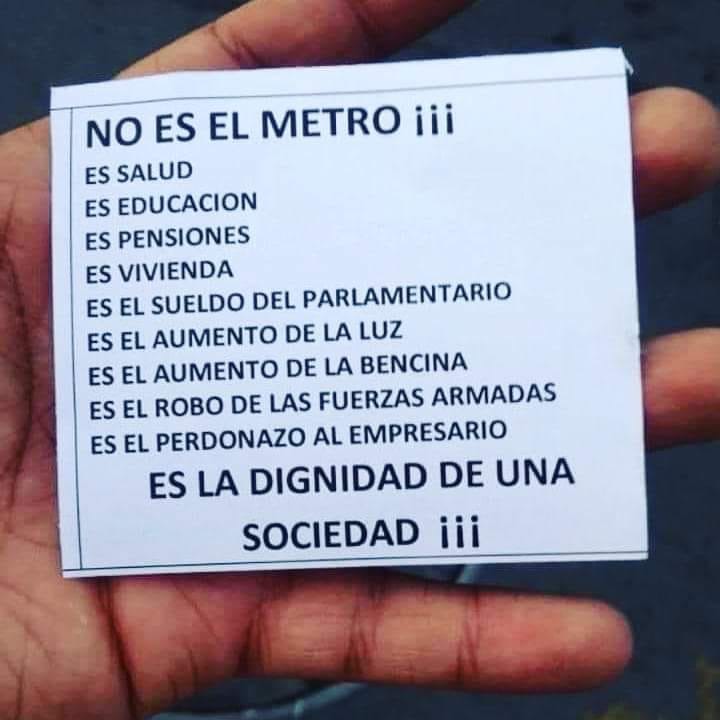
For those who don’t know, There have been huge protests in Chile since yesterday that, on the surface, appear to be about a rise in public transport fares. It takes only a little bit of reflection to notice this is just the tip of the iceberg.

For those who don’t understand Spanish, let me translate:

  • It is not about the subway
  • its about health
  • education
  • pensions
  • housing
  • politicians’ salaries
  • electricity prices surging
  • gas prices surging
  • the robbing done by the military
  • the carte Blanche for the business elite.

Sound familiar? It doesn’t take a lot to notice that almost all of these points apply to the U.S and that we too face severe inequality issues where the less affluent communities (at, around or under the median income levels) are being, little by little, getting the life squeezed out of them.

In Chile, this has reached a tipping point más massive protests have evolved into destruction of public and private property. I could only watch in awe yesterday of a video of the building of Chile’s largest energy generation and distribution company completely engulfed in flames (I worked there for over a year while in college).

It can be so tempting to think that everything we’re doing is trying to solve or move the needle on the inequality issues here in the U.S. But I also fear we may be part of the problem. By actively trying to use the tools of this flawed economic model to try to create prosperity, we may be just stretching the life span Of this dying and corrupt system when, in reality, it should collapse and disappear as soon as possible (I guess Anand Ghiridharatas mixed with the Joker (2019)).

I’ve been under a lot of distress these past couple of days. I can’t help but be on the verge of tears as I see all the videos, posts on social media and recounts by all of my friends and family still there.

What should we do? Should we mobilize and, with the same pitchforks, rise and seek to topple the system? Or should we keep working within its bounds, trying to find the best technical solution?

I guess I have much more to think about and this probably goes beyond the bounds of CPA. Maybe the introvert in me can find conciliation within this Internal conflict?

Our Influence, Our Voice, Our Legacy

Public Narrative

From a very young age, I realized the power of influence and that my voice carried weight.  At age five, I aspired to become a catholic priest. You see, I had been raised by a woman who never stepped foot in a school. She taught herself to read and write using the bible. My grandmother instilled in me that I could become whatever I wanted. Despite not having formal education, she was brilliant, so in my mind, she was right. She also raised me in the catholic faith. We would go to church every Sunday and lived the Franciscan values every single day. I remember one day, as I was enjoying delicious homemade apricot jam while inundating my grandmother with questions, Tere, our neighbor came over to talk to my grandmother. Tere was conflicted by the priest’s sermon. She was experiencing domestic violence and to turn the other cheek just did not make sense to her.  I remember thinking, but of course, the priest is a man. He doesn’t understand. That’s the problem!  

Kindergarten started, and when I was asked what I wanted to be when I grew up, I did not hesitate to answer, “I’m going to be a priest”.  Needless to say, that did not sit well with the nun. Long story short, I did not become a priest for obvious systemic reasons, but I always remembered the reason I wanted to become a priest- to use my voice and my power to inspire and influence others.  

As a professional, I have the honor of leading the Center for Community Wealth Building (CCWB) in Denver.  It is a movement-building organization that centers impacted communities at the core of growth. For so long, economic development has only included government and large corporations. This toxic relationship has created imbalanced and difficult conditions for those who were already at a disadvantage. In metro Denver, we are seeing legacy communities involuntarily displaced as a result of growth and gentrification.  We are seeing the fabric of our communities change because our communities were never included as part of the conversation. Through CCWB, I have successfully used my voice and influence to elevate those who have been at the margins. I have been able to organize and work with traditionally disenfranchised communities and established institutions to find alternative ways to use their economic engine, support local economies, and contribute to a sustainable way of life. 

Together, we have an opportunity to be bold. We need to develop and test a blueprint for inclusive economic strategies that build community wealth in communities of color and increase the economic stability of low-income families. Together, we can successfully implement these strategies that can offer a roadmap for shared prosperity to economically and racially marginalized communities at risk of involuntary displacement as a result of gentrification. Are you ready to join me in exploring how we use our power and influence to create a more just economy?   

A Legacy Worth Living

One of the three people I will interview is a Vice President at the Colorado Nonprofit Development Center (CNDC).  CNDC is a fiscal agent to 60 initiatives or programs throughout Colorado that range anywhere from $10,000 to $800,000 in annual budgets.  The VP and I already have a good working relationship, so I will start the meeting by thanking her for the support provided to CCWB to fundraise and grow our capacity.  She has learned a lot about me because she has asked me to present to their staff and board. I will use this time to get to know her better. I hope that some of the risks I have already taken will help her feel more comfortable with me.  

I will start by asking questions such as, “Are you originally from Denver? No, what brought you to Denver? What’s the story behind your name?”  I have proven Dale Carnegie’s quote, “you can make more friends in two months by becoming interested in other people than you can in two years by trying to get other people interested in you.”  Given my experience, I have an entire list of questions at my disposal to break the ice. 

Once I learn more about her personal story, I will ask her about how she uses her skills and passion to advance the work of CNDC. I would also like to ask, “when you retire, what do you want your legacy to be?” This will help me identify the motivator and driving force that can help us identify mutual benefit outside of cutting costs down the road.  

Balancing the relational versus the current transactional nature of our work with CNDC will definitely be a challenge.  CNDC is used to being the “well-oiled machine”. I, on the other hand, am comfortable sharing my personal story. In fact, my default is always relational. I rely on my organizational skills to take care of the transactional needs.  It is my hope that I can get to know the VP so that we can start from a place of abundance.   

My current challenge with my relational nature is that I have a difficult time prioritizing work/life balance when relationships are at play, and they usually are. It is difficult for me to say no when it is my community, my people, my relatives who are negatively impacted by displacement.  I feel irresponsible sitting back because I need a day off. While I understand, in theory, the importance of days off, my communities do not have that luxury. I am currently working with a coach to address this issue. It would truly help to know someone of Color who is fully committed to the cause and has prioritized a work/life balance.     

The meetings I enjoy most are those with whom I share a common interest.  I truly enjoy meeting with those who bring their uniqueness, sense of humor, and critical skills to the table.  Even if we disagree on approach, I get a lot out of conversations that respectfully challenge and strengthen my position.  At the end of the conversation, I like it when I feel that I have accomplished something, which includes getting to know someone better.  

Other Interviews

The other two people that I will interview are our local IAF organizer and a program officer at a local foundation.  Again, there is already a relationship with both, so it will be about aligning priorities to see where they intersect. 

Reflection Script

The goal of these meetings is to spark interest.  I am not wedded to the end product, but I am committed to figuring out how we best use the collective power of institutions to create a mutually-beneficial model that uplifts traditionally disadvantaged local businesses.  Given the strategic approach that Michelle, Paul and I are taking, I am confident that we will identify the next steps. Once we identify areas of need, we will assess the market to identify the current local businesses that can provide that product/service.  If there are gaps, we will work with business development organizations to communicate the need. It is my dream that eventually, more worker-owned businesses are also part of this model.  

During the initial relational meetings, I would like to also capitalize on the opportunity to bring a new lens to the interviewee’s perspective.  Personally, this is much bigger than CPA. For me, CPA is one model in which we can build and preserve community wealth, but there are many more. Even if CPA is not the right fit for these institutions right now, I want to invite them to reflect and see what other aspects can be incorporated to support a more sustainable way of life.    

In a sense, I find my CPA challenge easier to process than my personal one.  In theory, I do understand that respecting my time and prioritizing myself is the right thing to do.  Theory is easier than practice. Yet, through this process, I also realize that my voice is not the only thing that carries weight- my example does too.   I need to embody balance not just for myself, but for others as well. I owe it to everyone who is in this fight with me. I do not have all the answers yet, but I am committed to figuring it out.  

As of now, progress is what keeps me fueled.  Wins, even the smallest ones, provide the much-needed energy to keep fighting.  Opportunities also continue to be the light at the end of the tunnel. While this has worked, I want to identify other aspects, outside of work, that will provide the same level of satisfaction.  But I will admit, I am definitely a work in progress.  

Thank you all for the thoughtful questions!   

Walking in faith through the valley of shadows – finding the CPA promised land together.

The Denver Members of the cohort discussed the top nine key stakeholders and relational meetings we would like to have in order to build our network.  Each of us took 3 names.  The three relational meetings I will set up are with two leaders in other denominations, the Lutheran community in Colorado and the Methodist leadership in the Denver metro area.  I will also talk with the leadership in a local nonprofit that is a jubilee ministry within the Episcopal Church and works with individuals who are experiencing homelessness.

Since each are faith based, I will share with them elements of my own faith journey as well as my work in economic development.  I will share the journey of how I ended up working on these issues for the diocese, how I feel called by my faith to work with the poor and marginalized and the importance of shifting structures.

One risk will be in sharing my own struggles in working with parishes.  How this is difficult work and often frustrating.  Everyone feels the burden of these current times in the world and especially the United States, and everyone is stretched when it comes to time and resources.  Many church leaders are working for less because their parishes cannot afford to pay them fully.  I will share my own hope and my own sense of exhaustion and struggle to maintain my own faith.

I will ask them about their hopes and the struggles they are having.  I will want to learn about the specific work they are doing in their faith communities.  What do they see as most promising in dealing with struggling churches and struggling communities.  I hope to learn how they are approaching the pressing issues of the day.  Specifically, I am also interested in the Lutheran commitment to being a sanctuary church and the Methodist split on LGBTQIA issues and how they are dealing with this.

I tend to focus on the relational and as a result the necessary transaction issues can be overlooked.  This can bring confusion and frustration.  An example of this today was one of our jubilee ministries felt frustrated that I “had not gotten them grants”.  While this is not part of my job for them, because of our conversations and connections they felt I would be doing this for them.  The important part of both is setting boundaries as well as opening up the space for new possibilities.  I need to grow at setting boundaries, especially around time, while not artificially shutting out new ways of doing things and building new relationships.

I do know people who are good at this, though the ones who I most admire have moved away.  What I see in them, is the ability for self reflection without self shaming.  The ability to speak their truth clearly without fear, to set boundaries, but also to be open through deep listening and being fully present with those whom they encounter.

A sandbox we can all play in: bridging networks and inviting gym-churches to the table

The three relational meetings I am in the process of setting up are with the lead organizer of the IAF affiliate in LA, the director of the local PICO affiliate and a community leader he thinks I should talk to, and an entrepreneurial church-planting pastor whose congregation are becoming part-owners of a gym where church will also be held. I have met all three of these men before, and indeed had a regular one on one with two of them previously so this one on one is a reintroduction, of sorts, and an opportunity to both learn how and if they have done thinking around community purchasing, as well as whet their appetite for doing so.

In thinking about what story I want to tell, I have landed on wanting to share the story of attending Eastern Mennonite University and doing research on our institutional investments in the context of leading a student boycott, sanctions and divestment group. I want to share how I felt the invisible-made-visible complicity in an economy of death every time I passed the Caterpillar construction equipment on-campus knowing the impact of that company in the lives of Palestinians I had met and protested with. I want to share the inverse feeling of liberation I felt in planning a positive investment campaign buying hand-made keffiyeh’s from the Hebron women’s cooperative and how those seminal experiences birthed my passion for organizing our purchasing power as intentionally as we do our people power.

The biggest risk I anticipate taking, which directly overlaps with modeling vulnerability is in admitting where I am on this journey of exploring CPA, which is to say, I am still learning. As so often the case in my life, I am the newcomer here in Los Angeles and I must risk being told that any knowledgeable local would know what I am suggesting has already been done, is impossible, or is already in process. My inclination to do all of my research before speaking with people (not my typical approach, but for some reason my temptation in this endeavor) will have to give way to trusting I am coherent, trustworthy and intelligent enough to communicate the nuanced idea that while I am not entirely an expert, nor able to commit all of my time to becoming one, I can nevertheless provide the energy, guidance, and savvy to move this proposal forward while learning and respecting the necessary local context. In many ways this is the nuanced agreement I have had to make with every community and every employer that has ever trusted me with their time and work.

I have started with these three in part because there is already enough of an existing relationship that I feel I can be somewhat vulnerable, but also because there is so much I am genuinely curious about.

For the two leaders of broad-based organizations I am curious which of their members they might suggest I approach. I am curious if they might be inspired enough by the model to allow me to invite their organizing staff in as message multipliers and initial scouts for interested institutions. I am curious whether they are aware of any similar ventures having previously occurred. I am deeply curious whether they will see this as an opportunity to bridge whatever differences they may have and work together, and who they recommend I reach out to beyond their direct membership.

With the new gym-owner-pastor I am most curious about how he and his community decided to move forward with that model, and how they are aiming to live out Kingdom economics while helping run what I assume is a for-profit space.

I’m actually far less concerned than I have sometimes been about the relational versus transactional dynamic for the simple reason that at this point I’m approaching CPA similar to any campaign I imagined myself organizing with the IAF, which is to say, I’m waiting to see if it is genuinely within the self-interest of the community. I’m agitating to see if leaders who may be intrigued are also willing to actually support the idea. I cannot start a cooperative alone, and my professional, personal, and emotional well-being do not in any way depend on whether or not CPA LA gets established. This was a very hard lesson I learned as an organizer “You cannot want it more than the leaders”. I have not forgotten that lesson. I listed in my first week what I have to gain from this venture, but I don’t have much to lose which releases me from the concern that I would get overly transactional in my initial relational meetings.

The people who I know with whom meeting is a joy are those who I know are coming: 1) with their own energy and excitement 2) having thought through why they are meeting with me specifically 3) with a clear ask or question for me to consider 4) who truly listen to me and project a sense that they care about me as a person in the midst of their passion for the topic at hand. This human-touch combined with thoughtful approach make for the best meetings, and is the balance I will aim to emulate.
___

Ending with this exerpt from Mary Oliver, my forever inspiration:

Whoever you are, no matter how lonely,
the world offers itself to your imagination,
calls to you like the wild geese, harsh and exciting –
over and over announcing your place
in the family of things.

(Excerpt from “Wild Geese”, offered in the spirit of offering up this time and community to the wild harsh and exciting call of our greatest imaginations)

_______

Week 2 RS:
 
Thank you all for your engaging questions, thoughts and support! I heard the sense of detachment really resonating with several of you, as well as the organizing universal of never caring more than the leaders. I daresay if I didn’t have a stable job with good benefits, sound mental and physical health and a deep sense of my innate worth, the detachment would likely be more difficult. I struggled most with this concept as an organizer in large part because I was being paid (not a lot, certainly, but as compared to a volunteering it was a raise!) and measuring my professional success and aptitude by what I produced. The question to dig into for me, then, is how to maintain this detachment (which I agree is helpful and healthy right now) if and when my personal well being, career, etc is more at stake?

It’s ironic because on this “break” from being the organizer, paid staff, I had been eager to explore being a leader and allowing myself the freedom I had in college to drive action. In college it was my personal passion for solidarity and Palestinian rights that drove action at the university level. While it wasn’t my identity as a Palestinian, it was my identity as someone who had just been living there, who had friends personally impacted, and as a Christian whose values were in deep conflict with the complicity I saw. I say ironic because I have come to see that my status as the eternal outsider, particularly in a country (and world) in which oppression is largely the fatal mixing of white supremacy, capitalism and patriarchy, makes it necessary for me to take on the position of organizer regardless of that being my official position or not. That is to say, given what we have learned about positionality and my maturing in understanding where I stand in the current of history, I see that the task of agitating, catalyzing, and observing what is truly linked with the community’s self-interest must be core to all I do, as organizer or leader. Paul asked “If we think too deeply, it would freeze us in acting. What parameters do we put on not being complicit?” I think we name our complicity as honestly as we can, we surround ourselves as best we can with others that share our values and will make disentangling ourselves from the easy ties of complicity less painful, and we do the continual work of effort, grace, effort, grace, that trying to live well in this world requires. Even as I write this I know I’m circling around a dynamic learning I don’t quite have the right language for – so thank you for your patience.
 
Felipe asked if what I was looking for were co-conspirators – yes. Definitely. I’m looking for energy, knowledge, deep local knowledge and excitement at the adventure and opportunity of it all. You also asked if coming without all the answers is as much a strength as a risk. Yes. I think it depends what piece of the conversation, what part of the timeline we’re operating within. At this point I can certainly see it as both. Looking forward to continuing this dialogue with you all.